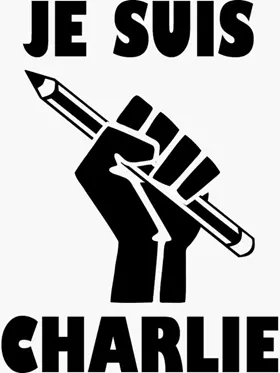
Image credit: Je suis Charlie fist and pencil, visual inspired by the “Je suis Charlie” slogan created by Joachim Roncin, 2015. Illustration of a fist holding a pencil, used as a symbol of freedom of expression and freedom of the press after the January 2015 attacks against Charlie Hebdo. Mondspeer, Je suis Charlie ,Freedom of Press [online], OpenClipart / FreeSVG, published 11 January 2015. Slogan “Je suis Charlie” created by Joachim Roncin, 7 January 2015.
Freedom of expression in France: understanding “Je suis Charlie”
In France, freedom of expression is not only a legal principle. It is part of the country’s political culture, its history, and its understanding of citizenship.
For many learners of French, discovering France means learning vocabulary, grammar and pronunciation. But it also means understanding the values that shape public life in France. Among these values, la liberté d’expression (freedom of expression) holds a central place.
Freedom of expression: a French republican value
Freedom of expression is closely linked to the French idea of the Republic. It means that citizens have the right to express opinions, criticise ideas, debate political choices, publish cartoons, question authority, and take part in public discussion.
This freedom is not unlimited. French law also protects people against defamation, hate speech, racism, antisemitism and incitement to violence. But the general principle remains strong: in a democratic society, ideas must be open to debate, criticism and contradiction.
In France, this right is deeply connected to the history of the Enlightenment, the French Revolution, secularism, the press and public debate. It is one of the reasons why newspapers, writers, artists and cartoonists have played such an important role in French society.
Charlie Hebdo and the attack of 7 January 2015
On 7 January 2015, France was deeply shaken by the terrorist attack against the editorial team of Charlie Hebdo, a French satirical newspaper known for its provocative cartoons and strong editorial independence.
Several members of the newspaper were killed, including well-known cartoonists. The attack was experienced in France not only as an attack against individuals, but also as an attack against freedom of the press, freedom of expression and democratic debate.
For many people in France and around the world, the question was not whether everyone agreed with Charlie Hebdo. Many did not. The central issue was whether journalists, cartoonists and citizens should have the right to express ideas, even controversial ones, without fear of violence.
“Je suis Charlie”: a slogan that became a symbol
In the hours following the attack, the slogan “Je suis Charlie” spread rapidly across France and internationally. It was created by the French art director Joachim Roncin on 7 January 2015.
The words were simple, but powerful. “Je suis Charlie” did not necessarily mean “I agree with everything Charlie Hebdo publishes.” For many people, it meant: “I stand with the victims. I defend freedom of expression. I refuse violence as a response to ideas, drawings or words.”
The slogan appeared on signs, social media profiles, posters, newspapers and public buildings. Millions of people took part in marches and gatherings in France and abroad. Pens and pencils became strong visual symbols, representing journalists, writers, artists and cartoonists.
Why the pencil matters
The image of a fist holding a pencil is powerful because it transforms a simple object into a symbol of resistance.
A pencil is not a weapon. It is used to write, draw, question, criticise and create. In the context of Charlie Hebdo, the pencil became a symbol of peaceful expression against violence. It reminded people that words and drawings can disturb, challenge and provoke but they belong to democratic life.
This is why images such as “Je suis Charlie fist and pencil” are still meaningful today. They connect several ideas: freedom of the press, civic courage, solidarity and the right to speak.
A difficult but necessary debate
The events of January 2015 also opened complex debates in France and abroad. Freedom of expression can be uncomfortable. Satire can shock. Cartoons can offend. Different countries, cultures and individuals do not always draw the same line between criticism, humour, insult and respect.
In France, these debates are often linked to another important principle: la laïcité, or secularism. French secularism protects the freedom to believe or not to believe, and it also allows religions, ideologies and institutions to be criticised in public debate.
Understanding this context is essential for anyone learning French and discovering French society. Language is never separate from culture. To understand French newspapers, political discussions, classroom debates or public demonstrations, it is important to understand why freedom of expression is such a sensitive and central topic in France.
Learning French also means understanding France
At French in Bordeaux, we believe that learning French is not only about memorising words. It is also about entering a culture, understanding its references and learning how to discuss important topics with nuance.
The phrase “Je suis Charlie” remains one of the most recognisable expressions of contemporary French public life. It reminds us that language can unite people, that symbols can travel across borders, and that democracy depends on the possibility of expressing, questioning and debating ideas.
Freedom of expression is not always simple. It requires responsibility, courage and respect for the law. But in France, it remains one of the foundations of civic life, and one of the key ideas to understand when learning the French language and culture.