You want to learn French, but grammar books feel cold, vocabulary lists get boring fast, and you still freeze when it’s time to speak? Learning French through reading is one of the most enjoyable and effective methods available today. When you learn French with books, you don’t just memorize words — you connect ideas, culture, and emotion. Here’s the good news: reading books in French can change everything. Hugo, Balzac, Molière, Camus, Voltaire … Whether you’re a beginner, intermediate or advanced in French, there’s a book out there that’s perfect for you. In this guide, you’ll discover why reading is such a powerful tool to learn French, what types of books to choose based on your level, and how to read in a way that actually boosts your fluency, not just your vocabulary. Ready to fall in love with French through stories?
Why reading is the best way to learn French with books
Reading is one of the most powerful and enjoyable way to learn French. Instead of memorizing endless word lists or grammar rules, books allow you to absorb the language naturally, in context. Reading shows you grammar in action: you’ll see how verbs are conjugated, how sentences are structured, and how tenses are used, all without having to open a grammar book. Over time, this makes grammar feel more intuitive. When you see words used again and again in different situations, you remember them more easily. You’re not just learning definitions, you’re learning how the language works and building vocabulary naturally.
Reading also improves your comprehension skills, which boosts your confidence in conversations. As you train your brain to follow along with sentences and paragraphs, your overall understanding of French becomes stronger. This pays off in conversations, because you’ll be quicker at understanding what people say. If you read aloud, it improves your pronunciation too.
And it’s not just about the language itself. Books give you a window into French-speaking cultures. Through stories, humor, idioms, and even the characters’ behavior, you start to pick up on cultural norms, references and values. Another major benefit is flexibility. You can read at your own pace, without the pressure of making mistakes in front of others. Whether you’re reading for five minutes on your lunch break or diving into a novel on a quiet weekend, it’s entirely up to you, and you can choose books based on your interests.
Reading regularly also helps you begin to think in French. Instead of constantly translating in your head, you start to recognize meaning directly in French. This shift is key to becoming fluent. Reading can make you fluent quickly through regular exposure and mental immersion. Whether you choose novels, short stories, or comics, learning French through reading offers endless opportunities to expand your vocabulary and confidence naturally. Once you learn French with books, you’ll start to think in French naturally and absorb vocabulary in context.
What French books should you read?
The best book to start with is the one that excites you. Whether it’s a comic, a classic, or a short story, interest makes reading much easier and more enjoyable. Think about your goals too : are you learning French for travel, work, or simply for fun? Choose something that fits your motivation.
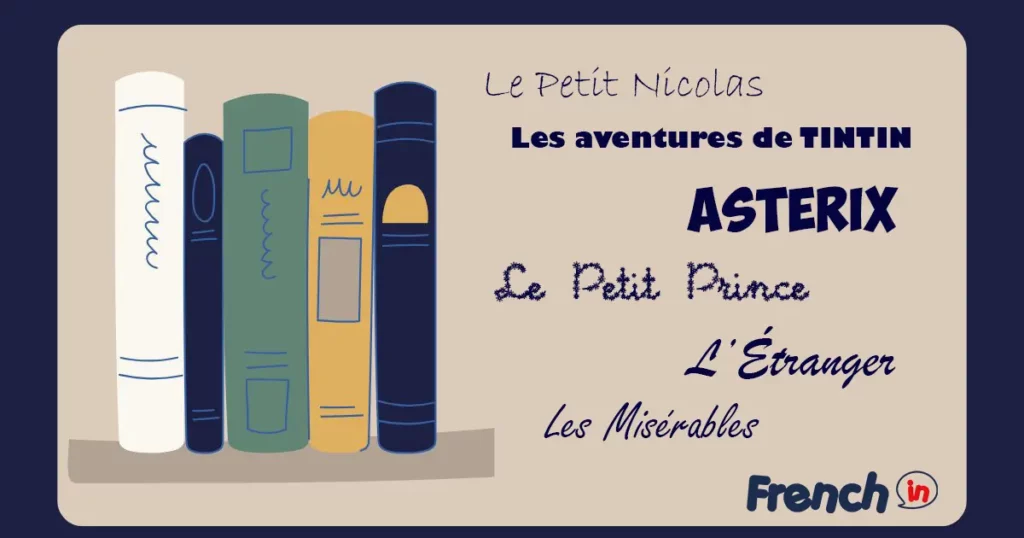
For beginners, it’s helpful to start with picture books, bilingual books (with French and English side by side), or simple books written for children. These often use basic vocabulary and clear sentence structures. A great place to start is Le Petit Nicolas by René Goscinny, short, funny stories using everyday language, or Oscar et la Dame rose, a simple book from Eric-Emmanuel Schmidt. Comics like Les Aventures de Tintin or Astérix are also perfect: the visuals help you follow the story, even when the words are tricky. Short Stories in French for Beginners by Olly Richards is another good pick, created especially for learners.
As you progress to an intermediate level, you can explore more complex stories like Le Petit Prince by Antoine de Saint-Exupéry. It’s poetic and rich with meaning, yet still accessible. You might also enjoy Petit Pays by Gaël Faye, a powerful novel that’s modern and moving. As you explore different genres, you’ll notice that French books for beginners and intermediate learners help you progress smoothly without feeling overwhelmed.
Advanced learners can dive into French literature, essays, and newspapers. Try reading L’Homme qui voulait être heureux by Laurent Gounelle, or explore classics like L’Étranger by Albert Camus and Les Misérables by Victor Hugo. French newspapers such as Le Monde or Le Figaro are also great for staying current and expanding vocabulary.
Don’t forget other genres like poetry, theater, or essays. For poetry, Les Fables de La Fontaine are timeless and fun to dissect. Theatre lovers might explore works by Molière or Racine. The French literary tradition is incredibly rich, with famous names like Victor Hugo, Albert Camus, Marguerite Duras, and Marcel Proust offering a lifetime of reading material.
You can find books at your local library, bookstore, or online. Check out websites like Fnac that offer books for learners, organized by levels or Mondes en VF for books adapted to French learners.
How to read in French effectively for language learning
To get the most out of your reading, it helps to be both relaxed and a little intentional. Start with what we call passive reading: just enjoy the story without stressing about understanding every word. Let your brain soak in the language. If you get the general meaning, you’re already learning.
But don’t be afraid of active reading, especially with shorter texts. Highlight new words, write down vocabulary in a notebook or an app, and look up grammar points that confuse you.
Re-read chapters to notice how certain structures are used. This kind of focus deepens your learning. Pairing reading with other skills can also make a big difference. Try listening to the audiobook while you follow the text, this helps improve your pronunciation and listening at the same time. Apps like Audible or free platforms like Librivox offer many options.
After reading, summarize chapters in your own words, either out loud or in a journal. You can even talk about the book with a language partner or in an online book club. Set small goals for yourself: maybe a chapter per week, or a certain number of pages per day.
Celebrate milestones, finishing your first book entirely in French is a big achievement! Reading is more than just a way to learn vocabulary: it’s a way to connect with the language emotionally and intellectually. Whether you’re curled up with a novel, flipping through a comic, or listening to an audiobook during your commute, every page brings you one step closer to fluency.
Reading in French isn’t just a study tool, it’s a doorway into the language as it’s really lived. Every page you turn brings you closer to fluency, not through pressure or perfection, but through curiosity, rhythm, and connection. You start recognizing patterns, hearing the music of the language in your head, and thinking more and more like a French speaker.
At French In, we integrate reading and writing into your learning journey. We can build lessons around books you love, and simply turn your interests into real language growth. If you’re ready to take your next step and learn French naturally, reading can be your bridge to real fluency.
Reading is also one of the easiest and most enjoyable ways to learn French with books and feel connected to the culture. At French In, you can explore a wide range of French language courses in France that combine reading, speaking and immersion, a natural way to learn French in context and gain fluency faster.